WORK — SELF-INITIATED
Hakkeyoi
DAILY REFLECTION WITH THE EIGHT TRIGRAMS — 2026
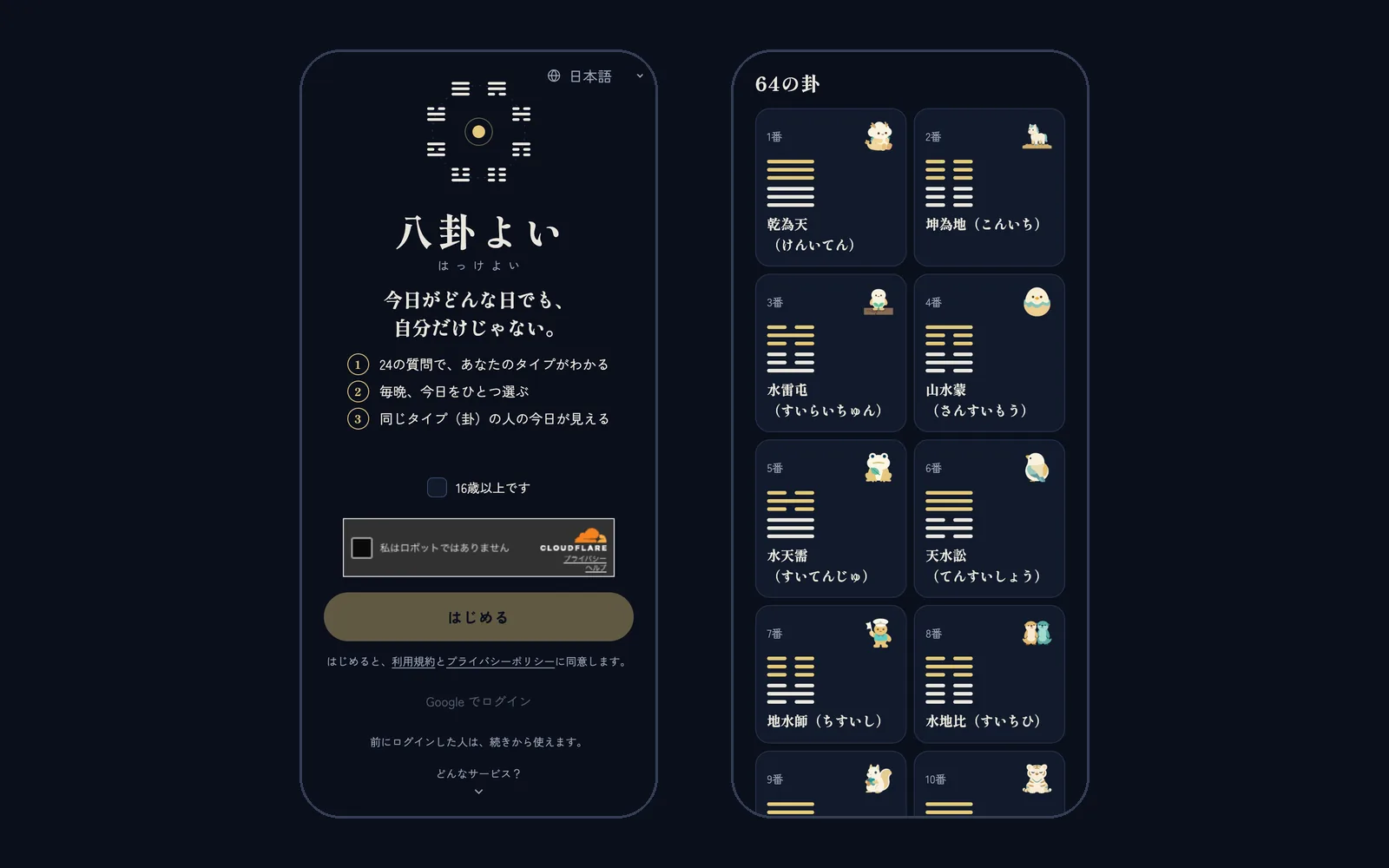
The live service (hakke-yoi.com), shown in Japanese.
Why we built it
Looking back on your day before bed is a habit most people agree is good and few manage to keep. A diary asks for too much writing, and mood-tracking apps tend to end up as a column of numbers.
And on a bad day, what helps is often not analysis but a simple sense that you were not the only one having a hard time.
So we made it one pick out of three each night, and a view of how people of your type are doing today. The types are borrowed from the eight trigrams of the I Ching. The name comes from hakkeyoi, the call a sumo referee gives to wrestlers who have stopped moving.
What it does
- A 24-question quiz, about three minutes. It tells you which of eight types — borrowed from the trigrams — you are closest to. Your answers and total score never leave your device.
- One pick each night. Choose "a good day", "so-so" or "not a good day". Your last three days then form one of the sixty-four hexagrams, and you get one small step for tomorrow.
- How your type is doing today. You can see the share of people of your trigram who had a good day. Groups smaller than ten are never shown as percentages, so no one can be singled out from a small count.
- A short note. You can add a line to your entry. Notes are shared among people of the same trigram only after more than a hundred people use the service in that language. Each note is checked by rules and AI, and there are no replies, names or follows.
- No sign-up to start. No email address — you begin anonymously. When you switch devices, you can carry your records over with a Google account.
- Reading for people who arrive from search. There are pages explaining the eight trigrams and each of the sixty-four hexagrams (in Japanese).
What this means for your project
We run this service end to end ourselves as well — concept, build, and the operation that follows. If you are building a web service that needs to work while holding as little personal data as possible, such as a place people can join anonymously, we can take it on the same way, starting from the first idea.